
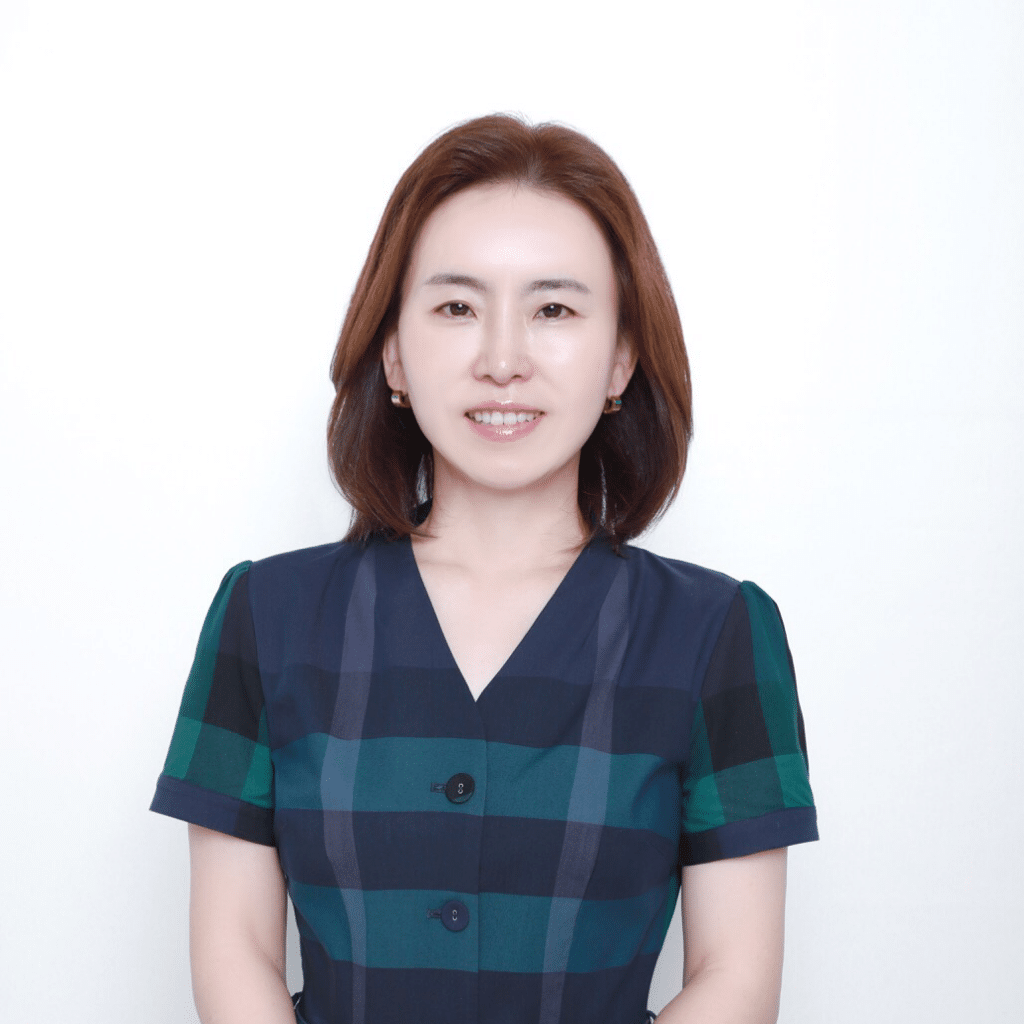
Sangmi Kim is a PhD candidate in Social Work at the University of Tennessee, Knoxville, with a minor in Intercollegiate Graduate Statistics and Data Science Program (IGSDSP). She earned her MSW from Ewha Womans University (Seoul, Korea) in 2013 and holds Korea’s highest-level national social worker license. She has professional experience providing mental health support in community welfare centers and contributed to Korea–Japan comparative child welfare research at the Korea Institute for Health and Social Affairs. She further advanced her international scholarship at the University of Tsukuba (Japan), where she studied NEET youth (Not in Education, Employment, or Training), hikikomori (prolonged social withdrawal), and youth volunteerism.
Her academic journey reflects a sustained commitment to addressing youth mental health challenges through family- and community-centered approaches. Her current research bridges youth mental health and digital innovation, with particular focus on suicide prevention, adolescent resilience, data justice, and culturally responsive AI-based dialogue. She primarily works with marginalized and at-risk youth, immigrant families, racial/ethnic minorities, and culturally diverse communities.
Methodologically, she employs advanced quantitative approaches, including psychometrics, machine learning, multimodal and multi-agent analysis, HITL (human-in-the-loop) AI, structural equation modeling (SEM), generalized linear mixed models (GLMM), and multilevel modeling. Through multidisciplinary collaboration, she designs practical and equitable digital health solutions, such as culturally responsive crisis hotline services that provide immigrant families with support in their native languages, AI-based multimodal and multi-agent systems, and HITL chatbots that enhance accessibility and equity in youth mental health.
Inspired by Nietzsche’s philosophy of Amor Fati—embracing challenges as opportunities for growth—Kim approaches both research and teaching with resilience and adaptability. She is committed to preparing future social workers to engage critically with digital technologies while upholding ethics, inclusion, and community-based practice. Her scholarship further emphasizes interdisciplinary collaboration and community partnerships that translate research into meaningful, real-world impact.
Research Interests
- Suicidology & data justice
- Immigrant youth & family resilience
- Machine learning & advanced quantitative methods
- Culturally responsive AI chatbots
Education
- PhD – University of Tennessee, Knoxville (in progress): Minor: Data Science (IGSDSP)
- MSW – Ewha Womans University, Seoul (2013)
- Research Student – University of Tsukuba, Japan (2006–2008)
- BA – Sungshin Women’s University, Seoul (2006)
Featured Publications
- Kim, A. H., Lee, U., Cho, Y., Kim, S., & Shah, V. B. (in press). Conceptually informed AI/ML for South Korean adolescent smartphone overdependency: Low-risk screening, construct exploration, and place-based policy implication profiles. International Journal of Environmental Research and Public Health. https://doi.org/10.20944/preprints202508.0028.v2
- Nugent, W. R., Clayton, H., Moulick, A., Mukherjee, N., Kim, S., & Fiddler, M. (in press). The relationship between violent political rhetoric and non-suicide, non-external cause (natural) death rates in the United States. Journal of the Society for Social Work and Research.
- Kim, S. (2024). A conceptual framework for mobile-based cyberbullying-related youth suicide risk screening and intervention. Journal of Human Behavior in the Social Environment, 1–23. https://doi.org/10.1080/10911359.2024.2318447
- Kim, S., Cho, L. L., Cheong, I., & Lim, B. R. (2011). The effect of internet usage types on adolescent depression and aggression mediated by school maladjustment and academic achievement: Focusing on gender difference. Journal of School Social Work, 20(20), 175–195. https://kiss.kstudy.com/thesis/thesis-view.asp?key=3579304
“I want to learn more and more to see as beautiful what is necessary in things; then I shall be one of those who make things beautiful. Amor fati: let that be my love henceforth!”
Friedrich Nietzsche, The Gay Science, §276 (trans. Walter Kaufmann)