
Social Work, PhD
Earn your Doctor of Philosophy (PhD) in Social Work at the University of Tennessee, Knoxville — a fully funded research doctorate with a $35,000 annual stipend, full tuition waiver, and health insurance for four years. Our program prepares scholars who advance social justice and improve lives through original research, innovative teaching, and policy leadership. An MSW/MSSW is required.
Program Overview
The University of Tennessee, Knoxville PhD in Social Work program creates scholars who develop and disseminate new knowledge about interventions, programs, and policies that advance social justice and improve the quality of life for vulnerable populations. As a research degree, the PhD emphasizes rigorous training in research methods, statistics, grant writing, teaching preparation, and theory — preparing graduates for careers in academia, research, and policy leadership.
UT’s PhD program is built on a mentorship model: students are paired with one or two research mentors from our internationally recognized faculty and work alongside them for 20 hours per week as part of the graduate research assistantship. You’ll contribute to funded research from your first semester, building the skills and publication record needed for a competitive academic career.
Resources for current students
Why Choose UT’s PhD in Social Work?
- Opportunities to develop teaching skills
- Extensive training in advanced research methods
- Mentorship from internationally recognized faculty experts
- Four years of competitive funding
Fully Funded for Four Years
Unlike many doctoral programs, every admitted PhD student at the UT College of Social Work receives a comprehensive funding package that includes a $35,000 annual stipend (12 months), a full tuition waiver, and graduate student health insurance — for four consecutive years. You are responsible only for some fees and textbooks. This means you can focus entirely on your research, coursework, and professional development without accumulating significant doctoral debt.
Mentorship from Internationally Recognized Faculty
UT’s PhD program pairs each student with one or two research mentors whose expertise aligns with your interests. You’ll work alongside your mentors for 20 hours per week as part of your graduate research assistantship, contributing to funded projects and co-authoring publications from your first year. Our faculty are nationally recognized leaders in areas including:
- Veterans services and military families
- Child welfare and family services
- Behavioral health and substance use
- Health disparities and healthcare social work
- Community-engaged and participatory research
- Trauma-informed practice and resilience
- Gerontology and aging services
- Social policy and social justice
Three-Paper Dissertation — Built to Publish
UT’s PhD program uses a three-paper dissertation model, meaning your dissertation consists of three publishable-quality research manuscripts rather than a traditional five-chapter monograph. The first paper begins as your comprehensive examination — a significant scholarly paper demonstrating your knowledge of a substantive area and your ability to integrate it with the program’s foundation content. This format accelerates your publication record and better prepares you for the academic job market, where peer-reviewed publications are essential for tenure-track positions.
Extensive Research Training
The PhD curriculum provides advanced, progressive training in both quantitative and qualitative research methods, preparing you to design, fund, and execute independent research. Core coursework includes:
- Research design and methods (quantitative, qualitative, and mixed methods)
- Advanced statistics (multivariate analysis, structural equation modeling)
- Grant writing (federal and foundation funding mechanisms)
- Community-engaged research methods
- Teaching preparation (pedagogy, curriculum design, supervised teaching)
A Vibrant Research Community in Knoxville
Located in Knoxville, Tennessee, the UT College of Social Work combines the resources of a major R1 research university with a close-knit, supportive academic community. You’ll have access to UT’s extensive research infrastructure — including interdisciplinary research centers, statistical consultation services, library resources, and conference travel support — while benefiting from the mentorship and collegial environment of a program that admits small cohorts each year.
Curriculum
The PhD curriculum includes required coursework, electives, and mentored research opportunities. Required coursework includes:
- 34 credit hours of research design, statistics, advanced critical thinking, and teaching methods
- Nine (9) credit hours of electives in related social and behavioral science areas
All PhD students are required to pass the comprehensive examination and an oral defense of the research proposal after their second year of coursework. The comprehensive examination consists of a significant paper demonstrating the student’s knowledge of a substantive area and the student’s ability to integrate that knowledge with the foundation content of the program. This paper is the first paper in the student’s three-paper dissertation.
We encourage you to visit our program and discuss your educational and professional goals with our PhD Program Director, faculty, and current students.
Curriculum Phases
Years 1–2: Foundation Building Students complete intensive coursework in research methods, statistics, theory, and teaching preparation. You’ll also begin working with your research mentor(s) on funded projects, gaining hands-on research experience from day one.
Year 2–3: Comprehensive Examination & Specialization After the second year of coursework, all PhD students must pass the comprehensive examination — a significant scholarly paper demonstrating mastery of a substantive area. This paper becomes the first paper in your three-paper dissertation. You’ll also complete an oral defense of your research proposal and begin your dissertation research.
Years 3–5: Dissertation Research & Completion You’ll conduct independent research, collect and analyze data, and write and defend the remaining two papers of your three-paper dissertation. Many students present at national conferences and submit manuscripts for publication during this phase.
PhD vs. DSW: Which Doctoral Degree Is Right for You?
The University of Tennessee offers both a PhD and a Doctor of Social Work (DSW) — two distinct doctoral degrees that serve different professional goals. Understanding the differences will help you choose the path that aligns with your career.
Choose the PhD if you want to produce original research, publish in peer-reviewed journals, secure grant funding, and pursue a tenure-track faculty position at a research university.
Choose the DSW if you want to advance into senior clinical leadership, executive administration, or practice-focused teaching — without leaving your career.
Both degrees are terminal doctoral credentials. UT is one of only a handful of institutions in the country that offers both a PhD and a CSWE-accredited DSW, giving you the opportunity to choose the path that truly fits your goals.
What Can You Do with a PhD in Social Work?
A PhD in Social Work opens doors to careers at the highest levels of academia, research, policy, and organizational leadership. PhD-prepared social workers are in high demand — CSWE has documented an ongoing national shortage of doctoral-prepared social work faculty, making the academic job market stronger for PhD graduates than in many other social science fields.
Tenure-Track Professor
Teach courses, conduct independent research, publish scholarly work, secure grant funding, and mentor the next generation of social workers at colleges and universities nationwide.
Research Scientist / Senior Researcher
Lead grant-funded research projects at universities, research institutes, think tanks, and government agencies. Organizations like the Urban Institute, RAND Corporation, and Mathematica employ PhD social workers.
Federal Research & Policy Analyst
Shape national social policy at agencies including SAMHSA, the Administration for Children and Families, the VA, NIH, and the CDC.
Executive Director / Nonprofit Leader
Lead complex organizations with the research expertise to evaluate programs, secure funding, and drive evidence-based decision-making.
Program Evaluator / Consultant
Provide expertise in research design, program evaluation, and evidence-based practice to organizations, foundations, and government agencies.
Salary Context
According to the Bureau of Labor Statistics, doctoral-level social workers consistently earn $20,000–$25,000 more annually than MSW holders. Social work employment is projected to grow 6% nationally from 2024–2034, faster than average, with approximately 74,000 annual openings. The demand for doctoral-prepared faculty and researchers is especially strong, as the profession works to fill a well-documented national faculty shortage.
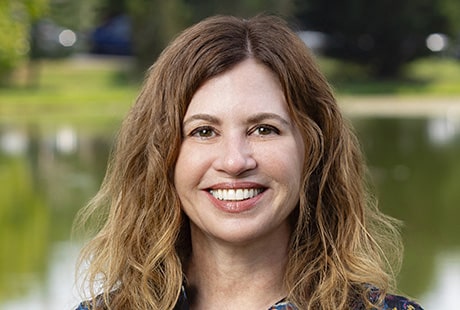
As a PhD student at the College of Social Work, I value our commitment to community-centered approaches that uplift marginalized voices. For me, social work is about empowering underrepresented communities and promoting lasting change by meeting people where they are and working collaboratively to build pathways to a more just and inclusive future.
Eliza GalvezPhD Canidate

Guided by Ethical Principles
The PhD program is designed with the National Association of Social Workers (NASW) Code of Ethics in mind. We pride ourselves on a curriculum updated with the standard’s latest guidelines on self-care, cultural competence, and a commitment to the profession’s mission and core values.
Funding
All admitted PhD students receive a fully funded research doctorate with a $35,000 annual stipend, full tuition waiver, and health insurance for four years.
Students are responsible for some fees and the costs of textbooks. The GRA is not just a funding mechanism — it’s a core part of your doctoral training. You’ll be paired with faculty mentors whose research aligns with your interests, gaining hands-on experience in research design, data collection, analysis, and publication.
UT faculty are engaged in a wide range of funded research projects, so you’ll likely find mentors who can help you gain experience in your specific areas of interest. Many students also pursue external fellowships (e.g., CSWE Minority Fellowship Program, Ford Foundation, NIMH F31) to supplement their funding and build their CV.

First Generation Doctoral Program
Dreaming of a doctoral degree in social work but not sure where to start or which program is right for you? The UT College of Social Work’s First Gen Docs Program is designed to prepare first-generation scholars for successful matriculation into a doctoral program in social work.
The program is built on three key pillars: connection, community, and education — and it’s open to prospective students considering either the PhD or DSW.
Admissions
Application & Admissions
The PhD program is designed for students who have earned a master’s degree from a CSWE-accredited school of social work and have post-master’s social work practice experience.

How Can We Help?
We’re here to help you learn more about applying to and attending our PhD program at the College of Social Work.
Reach out for more information, attend an information session, or contact us directly with any questions you may have.
Questions? Reach out!