

2026 One Health Systems Summit
October 31, 2026 | San Antonio, TX
Pre-Conference Workshop | 2026 APHA Annual Meeting and Expo
REGISTER TODAY
The One Health Systems Summit is a one-day, plenary-only convening that brings together leaders from across health, housing, social services, animal welfare, education, and policy to address the structural failures affecting families with pets. Held as a pre-conference workshop at the 2026 APHA Annual Meeting and Expo—the largest public health gathering in the United States—the Summit is designed not as a traditional conference, but as a field-building movement focused on redesigning governance, policy, workforce integration, and funding structures so that systems better reflect the needs of modern families.

The One Health Systems Summit at a Glance
The morning sessions diagnose how systems define family, where those definitions collide with reality, and what the resulting fragmentation looks like in practice. The afternoon shifts to repair: examining lessons from a Pop-Up One Health Clinic, identifying the structural barriers to alignment, exploring working models, and building a shared action agenda.
| Time | Session |
|---|---|
| 8:00 – 8:30am | Arrival & Informal Networking |
| 8:30 – 8:50am | Welcome & Framing Why One Health Systems — and Why Now – Michael Blackwell, DVM, MPH, Founder & Director, Center for Pet Family Well-Being |
| 8:50 – 9:35am | Opening Keynote From Fragmentation to Alignment: Why Systems Must Change – Amelie G. Ramirez, DrPH, MPH, Director of Institute for Health Promotion Research, Chair of the Department of Population Health Sciences at UT Health San Antonio, Associate Director of Cancer Outreach and Engagement at Mays Cancer Center |
| 9:35 – 9:45am | Moderator Bridge Connecting Structural Urgency to the Human–Animal Bond – Claire Shuch, PhD, Associate Director of Research, Center for Pet Family Well-Being |
| 9:45 – 10:40am | Session I — The Human–Animal Bond Why the Bond Matters to Systems, Not Just Individuals – Panelists: Christine Kim, Founder & Executive Director, My Dog is My Home; Vanessa Ashall, Human-Animal Interaction (HAI) Technical Leader, Waltham Petcare Science Institute; Rustin Moore, DVM, PhD, Dean, the Ohio State University College of Veterinary Medicine |
| 10:55 – 11:50am | Session II — How Systems Assume Family—and When Systems Collide Design Choices, Legal Frameworks, and Their Consequence – Part 1 – Panelists: Ross Barker, Director, Pet-Inclusive Housing at Michelson Found Animals Foundation, Inc.; Stacey Evans, JD, Founder & Principal, JurisPet Animal Health Meghan Davis, DVM, PhD, MPH, Chair, Master of Public Health Program, Associate Professor, Johns Hopkins Bloomberg School of Public Health |
| 12:00 – 12:50pm | Session III — How Systems Assume Family—and When Systems Collide Design Choices, Legal Frameworks, and Their Consequences – Part 2 – Panelists: Ingrid Taylor, DVM, Director of Guidelines, American Animal Hospital Association; Jada Ford, Research Fellow, Companions and Animals for Reform and Equity; Michelle Evason, DVM, BSc, DACVIM, MRCVS Director, Education & Outreach for Antech Diagnostics, Mars Petcare, Science & Diagnostics |
| 12:50 – 1:45pm | Lunch |
| 1:45 – 2:30pm | Session IV — What We Learned in Real Time Insights from the Pop-Up One Health Clinic – One Health Clinic Team |
| 2:45 – 3:35pm | Session V — Why Are We Not Aligned Incentives, Regulation, and Structural Barriers – Panelists: Anna Stout, MA, CAWA, Executive Director, AlignCare Health Inc.; Kelly Bremken, MSSW, LCSW, Veterinary Social Worker, Oregon Humane Society; Jessica Simpson, Public Policy Specialist, Humane World for Animals |
| 3:50 – 4:35pm | Session VI — What Aligned Systems Would Require Governance, Workforce Integration, and Sustainable Models – Panelists: Emily McCobb, DVM, MS, DACVAA, Professor of Clinical Accessible Veterinary Care, PetSmart Charities Endowed Chair in Accessible Veterinary Care at the University of California, Davis; Katie Kuehl, DVM, Associate Professor, Shelter Medicine & Outreach, Washington State University College of Veterinary Medicine; Michael Yellow Bird, MSW, PhD, Professor, University of Manitoba Faculty of Social Work; Jon Geller, DVM, DABVP, MPH, Adjunct Faculty, Colorado School of Public Health |
| 4:40 – 5:15pm | Session VII — From Vision to Action + Closing What Changes Because This Summit Happened – Michael Blackwell, Founder & Director, Center for Pet Family Well-Being |


Delivered in partnership with the University of Washington Center for One Health Research, Washington State University College of Veterinary Medicine, The Street Dog Coalition, and Street Medicine San Antonio the Pop-Up One Health Clinic will be held the day before with the Summit as a real-time systems stress test.
By integrating human health care, veterinary services, and social supports in one setting, the clinic reveals where systems function effectively and where gaps persist. Insights from the clinic will be shared during Session IV, anchoring the afternoon’s structural discussions in direct, lived experience.





Who Should Attend
The Summit convenes professionals across four sectors whose collaboration is essential to systems change.

Health and Well-Being
Veterinarians, clinicians, public health professionals, social workers, mental health providers, animal welfare leaders, and animal control officers

Education, Policy
and Research
Animal law scholars, policy researchers, veterinary and medical schools, think tanks, and community outreach programs
Housing and Transportation
Housing advocates, municipal policy experts, real estate developers and property managers, public transit professionals, and pet transport services

Economic and Community Support
Funders, foundations, community health organizations, faith-based and civic groups, employers, and nonprofit leaders
No single sector can solve these challenges alone.
The Summit is designed to create the conditions for cross-sector collaboration that lasts.

Intended Outcomes
- A shared, cross-sector framework for One Health systems alignment
- Identification of structural barriers in law, policy, funding, and governance that impede coordinated care for pet-inclusive families
- Actionable policy directions and near-term pathways for continued collaboration
- Strengthened partnerships among animal welfare, human health, housing, and social service organizations
- A credible, sustained platform for advancing pet family health equity beyond the Summit itself
Thank You to Our Summit Sponsors!



REGISTER TODAY
How to Register for the One Health Systems Summit
Attending only the One Health Systems Summit? You still need an APHA account to access the registration system. You do NOT need to be an APHA member or register for the full APHA Annual Meeting to attend the Summit.
1. Go to the APHA 2026 Registration page and click Register Now.
2. Sign in to your APHA account.
If you already have an APHA account, enter your account information and sign in.
If you do not have an APHA account, select Create a New Account and create one.
Important: Creating an APHA account simply allows you to use the APHA registration system. You can still register only for the One Health Systems Summit.
3. If you are not an APHA member, select Register as a Non-member. You do not need to join APHA to attend the One Health Systems Summit.
4. Open the APHA Code of Conduct/Participation Policy Agreement, then check the box confirming that you accept the agreement.
5. Enter the required registration information.
6. When you reach the registration options, if you are attending only the One Health Systems Summit, select: Individual Workshop/Session Only Registration.
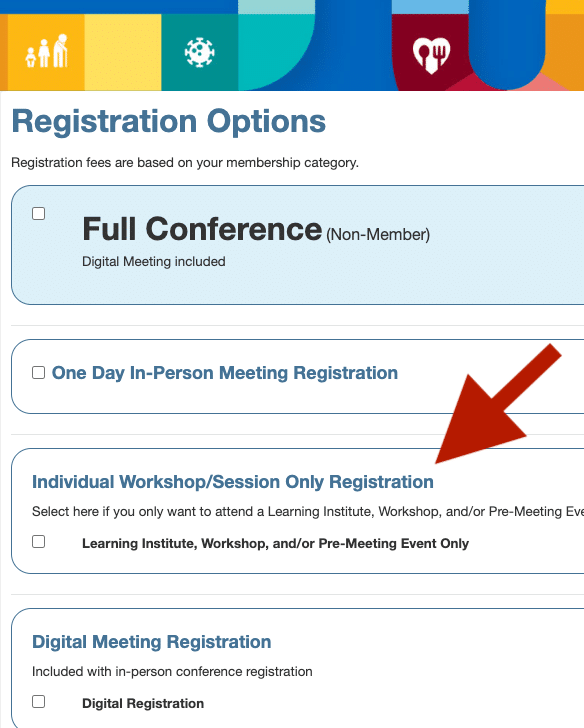
If you are also attending the full APHA Annual Meeting, select the appropriate conference registration option instead.
7. Select: Learning Institute, Workshop, and/or Pre-Meeting Event Only.
Then click Continue.

8. Under Pre-Meeting Events, find:
One Health Systems Summit — October 31, 2026
Select the Summit and continue.
9. Review your registration information and select Save/Checkout.
10. After completing registration, you will receive a confirmation by email.
12. Registration information will be emailed to you.
Having trouble finding the Summit?
Make sure you have first signed in or created an APHA account and selected Individual Workshop/Session Only Registration. The One Health Systems Summit will then appear under Pre-Meeting Events.
For questions about the Summit,
attendance, or partnership inquiries:

The Center for Pet Family Well-Being
is a proud recipient of funding
from Maddie’s Fund, a Duffield Foundation.
