

Our research examines access to veterinary and behavioral care, the human–animal bond, and the role of pets in human health, recovery, and social connection. Together, these areas help us understand how pet and human well-being are connected. By integrating pets into social service and healthcare systems, we aim to advance equitable, One Health-aligned approaches for all family members—human and animal alike.
Access to Care and Services
CPFW also studies the barriers that prevent families from accessing veterinary and behavioral care for their pets. Through national data collection and analysis, we identify the social, economic, and structural factors that limit access to essential services. We also examine how these barriers affect pet and human health and well-being. In turn, this research informs future studies, policies, and practices designed to reduce those barriers.


Access to Veterinary Care: Barriers, Current Practices, and Public Policy (2018)
Through a generous grant from Maddie’s Fund®, the Access to Veterinary Care Coalition (AVCC) commissioned this national population study to better understand the barriers to veterinary care experienced by pet owners across the socioeconomic spectrum. The study also sought to understand the knowledge, attitudes, and practices veterinarians have regarding access to veterinary care.

California Animal Welfare Working Group Animal Shelter Survey Report (2022)
With a geographic focus on California, the study was designed to answer three key questions:
- Do animal shelters in California indicate that they are experiencing a lack of access to veterinary care?
- What types of care can or cannot be provided?
- What are the effects of the shelters’ lack of access to veterinary care?

Access to Veterinary Care and Animal Welfare Organizations (2023)
The purpose of this study is to better understand the challenges animal welfare organizations face around access to veterinary care and how these challenges impact the animals in their care.

Racial Disparities in Animal Welfare (2024)
Research questions guiding this study were:
- How are pet adoptions procedures and practices impacting different racial and ethnic groups within a community?
- What differences exist in how different racial and ethnic groups within a community are impacted by policies and procedures of animal control agencies and animal welfare organizations?

From Academia to Action: The AlignCare Journey in Pet Health Equity (2024)
AlignCare is more than a system; it is a movement toward family health equity, endeavoring to eliminate disparities in care.

Access to Veterinary Care: Barriers and Insights from Pet Families (2025)
This report builds on the 2018 national study and offers an updated look at the challenges families face when trying to access veterinary services. The findings highlight the urgent need for expanded veterinary care access, local support services, and community-focused outreach to keep pets healthy and families together.

Co-occurring Unmet Needs in Human and Veterinary Care: Structural Barriers and Severity of Veterinary Outcomes Across US Households (2026)
Access to healthcare is often examined separately in human and veterinary contexts; however, unmet needs co-occur within households and reflect shared structural constraints. This study sought to characterize the co-occurrence of unmet human and veterinary care needs and examine their association with structural barriers and severity of veterinary outcomes in US households.

Pet Family Support Systems
CPFW is developing a framework to assess and enhance community support systems for pets and their families that will foster effective collaboration between the health and well-being sector; economic and community support sector; housing, transportation and infrastructure sector; and education, policy and research sector to strengthen the One Health approach.
We are developing a comprehensive community assessment tool to include pets in human-centered services.
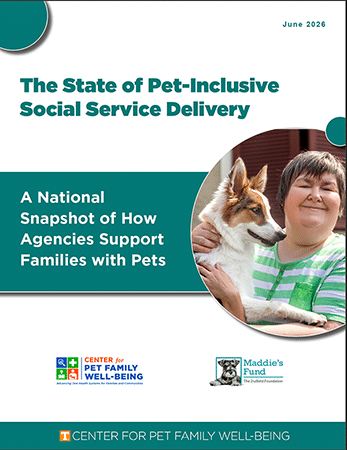
The State of Pet-Inclusive Social Service Delivery: A National Snapshot of How Agencies Support Families with Pets (2026)
This national report examines how social service agencies are including pets in service delivery and where opportunities remain to better support pet families. Based on a survey of 209 agencies across 43 states and Washington, DC, it explores current pet-related services, barriers to implementation, cross-sector collaboration, and the resources agencies need to strengthen pet-inclusive practices.

Understanding how social service agencies support families and their pets: A national survey (2026)
Pets play a critical role in family well-being, yet poverty, housing instability, domestic violence, or other crises often form barriers to accessing services, while pets face parallel risks, including inadequate nutrition, loss of veterinary care, or surrender. Despite growing recognition of One Health frameworks, little is known about how social service agencies (SSAs) recognize or serve the needs of families with pets. This study examines how SSAs address clients’ pet-related needs, what facilitates or hinders collaboration with animal welfare organizations, and what resources agencies need to integrate pets into service delivery.
Pet Family Health and Well-Being
CPFW is conducting various studies that explore the depth and dynamics of the human-animal bond, focusing on how these relationships impact the overall health of families. The research will utilize various health metrics to draw significant correlations between bonded family units and their health outcomes.
- Understanding the Role of Pets on Substance Use Recovery and Well-Being
- Understanding the Role of Pets on Senior Well-Being and Senior Living Communities
- Understanding the Role of Pets on Veteran Well-Being


Understanding pet impacts on quality of life and loneliness: A mixed-methods study in a public housing setting
Pets play an important role in the lives of pet families, yet their impacts within low-income communities remain largely underexamined. Guided by a One Health framework, this mixed-methods study examined how living with pets influences quality of life (QoL) and loneliness among residents in three income-restricted, multifamily housing communities in the Southeastern United States, two of which primarily serve older adults and individuals with disabilities.
The Center for Pet Family Well-Being
is a proud recipient of funding
from Maddie’s Fund, a Duffield Foundation.

Thank You to Our Current Project Funders!


Thank You to Our Past Funders!


